
So foam rolling has turned into a global phenomenon. And with very little research to back up the fact that it does anything of benefit. Now i’m sure i’ll have many people getting upset with me over this statement, but its true. There isn’t much in the way of solid scientific research that shows foam rolling does anything. Everyone has an opinion such as; it helps to loosen my muscles; it pushes lactic acid (does not exist) out of my muscles; it releases my fascia etc. Lots of lovely statements, but so far we don’t have proof. What we do know is that after tolerating the excruciating pain of rolling your IT band or your hips you seem to feel better. You feel looser, and are able to move that little bit better.

So here is the interesting part. So far there is no negatives to doing foam rolling. There is no indication that it will lead to a torn muscles, or increased likelihood of brain aneurysm. Because there is no great risk, I say foam roll away. My take on it is this. The risk of foam rolling is very low, and the benefits appear to be individual specific, but that benefit seems to be derived from foam rolling. So feel free to foam roll, but don’t necessarily think that because it hurts somewhere that by smashing that area till you are blue in the face you will be “fixing” something. Because that hasn’t been proven and so that statement shouldn’t be made!
I tend to look at foam rolling as numbing up a particularly tight area of muscle/fascia/tendon. Once numb it will allow you to feel like you can move more freely, and because of this will move in a better movement pattern. The better you move, the more your nerves get trained to move better, and lead to you actually moving better. This in turn will actually lead to you being more limber because your nervous system will allow it. Thats my analogy, and best guess at why foam rolling works, but remember this is only conjecture and not hard science so please don’t pass it off as such.
My two favourite foam rolling areas that I derive maximum benefit from are the Iliotibial (IT) Band and your thoracic spine. The IT Band is often neglected simply because it hurts, and the Thoracic Spine is often done improperly.
The IT Band.
The first step is realizing that yes its going to hurt, and NO just smashing the most painful area wont give you the most benefit. You need to work the entire length of the tissue. Your IT Band is curved and so you need to do three different passes down it focusing on each plain. The next part is realizing that you need to do from your knee up and into your glutes. The IT Band is simply a thickened piece of fascia along the lateral side of your quadriceps muscle called your vastus lateralis. Work the entire length! Spend roughly 5 minutes per leg at least 3-5 times per week. Do this before you work out to allow your body to move better throughout it’s range of motion.

The Thoracic Spine.
Your thoracic spine is between your neck and lumbar spine. It supports your rib cage, and the presence of ribs is how you can differentiate the thoracic spine from your cervical and lumbar. Your thoracic spine is commonly flexed forward and limited in extension which is needed for proper shoulder function, and can be an injury causer for the cervical and lumbar spine as they will compensate for this lack of flexibility. Using a foam roller you can roll the length of your thoracic spine to encourage extension out of it. The key here is to prevent your lumbar spine (lower back) from extending to compensate. I see this frequently and it’s one of my biggest pet peeves. You should hold your core tight and focusing on bending your thoracic spine only over the foam roller. Most often I see people dip and let there bum rest on the ground and extend their neck to give the illusion of increased flexibility. The below pictures, the first one is done correctly and the second is incorrect. If you look like the second get your abs tight. Chances are you wont be as flexible through your thoracic spine as you think you are. Spend 3-5 minutes on this movement every day if you have flexibility issues in the thoracic spine.

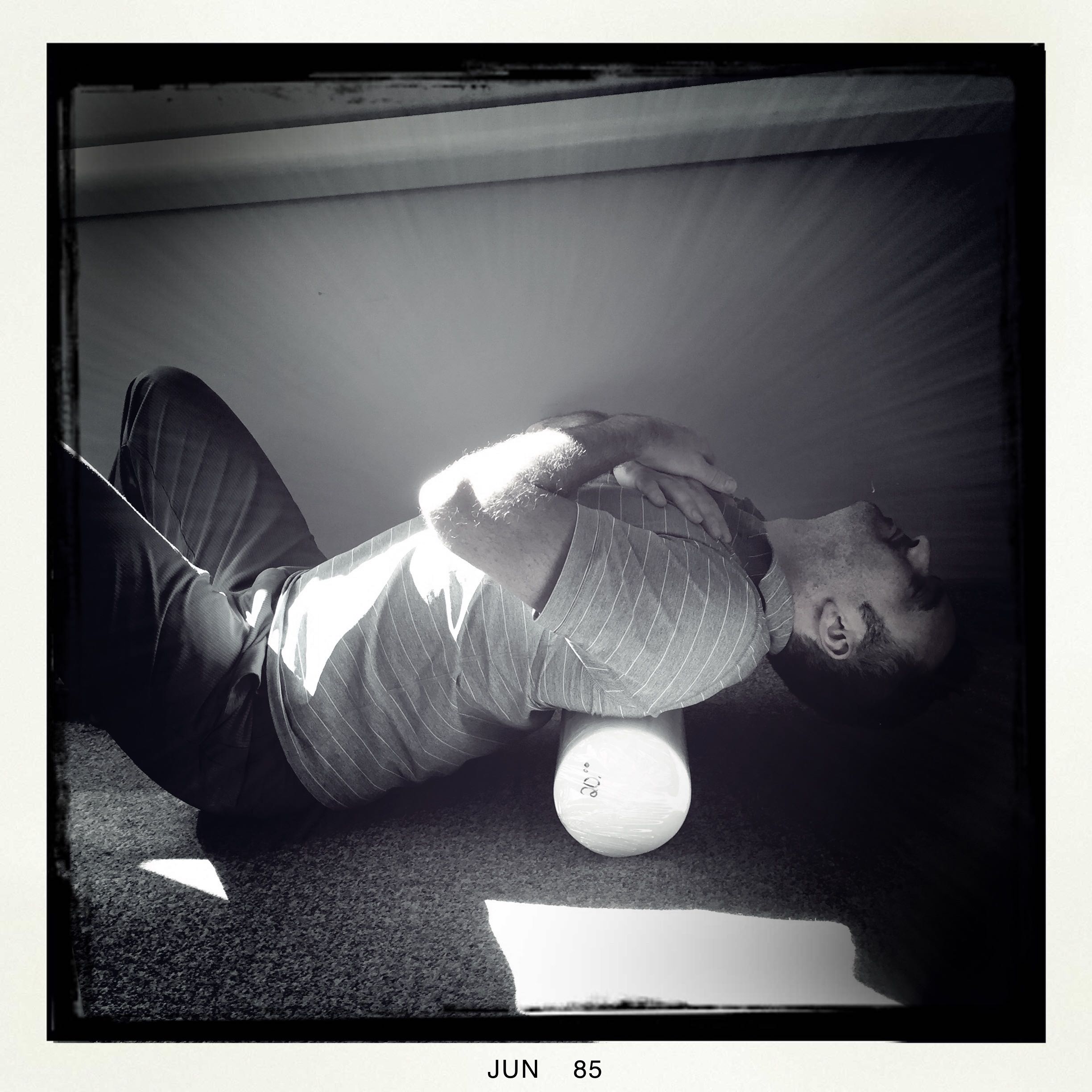
There are many more options, but these are my two favourites that are either under-utilized or simply done wrong. Think about the position you want to be in when doing a movement and mimic that. Don’t compensate on the foam roller unless you want to be in a compensated position when you are lifting weights or doing daily tasks.
– Dr. Adam Wade-
 Dr. Adam Wade